
How AI-Powered NPCs Are Changing Modern PC Gaming
Last updated:
Checked 29 August 2026. Engine features, game implementations and hardware requirements can change.
“AI NPC” is an imprecise label. In most games, a believable non-player character is still built from authored rules, animation, navigation and carefully limited choices. New machine-learning and natural-language tools can extend that toolkit, but they do not replace game design or guarantee a smarter character.
Six systems that are often called AI
Scripted behavior and finite states
A scripted guard might patrol, investigate a sound, chase the player and return to a post. Designers decide the states, transitions and permitted actions. This is predictable, inexpensive to run and easy to test—qualities that matter more than novelty in many encounters.
Behavior trees
Behavior trees arrange decisions into branches and tasks. Epic’s Unreal Engine documentation describes a tree working with a Blackboard that stores values such as a target or last-known location. The result is still authored logic, but it can be easier to inspect and reuse than one large script.
Procedural systems
Procedural generation creates or combines content from rules and seeds. It may vary patrol routes, encounters or dialogue fragments without learning from players. Randomness is not the same thing as machine learning, and procedural output still needs constraints.
Machine learning
A trained policy can choose actions from observations. Unity’s ML-Agents toolkit supports reinforcement learning, imitation learning and other training workflows for Unity environments. Training normally happens before release; shipping a model does not mean an NPC is continuously learning from every player.
Natural-language systems and generative AI
Speech recognition can convert a player’s voice to text; a language model can generate a response; text-to-speech and animation systems can present it. NVIDIA ACE groups these capabilities for cloud or on-device use. Its documented examples include an AI advisor for Total War: PHARAOH, co-player characters demonstrated for PUBG, learning bosses in MIR5 and “Smart Zois” in inZOI. Those examples have different roles and availability, so they should not be treated as one universal NPC system.
What changes for players
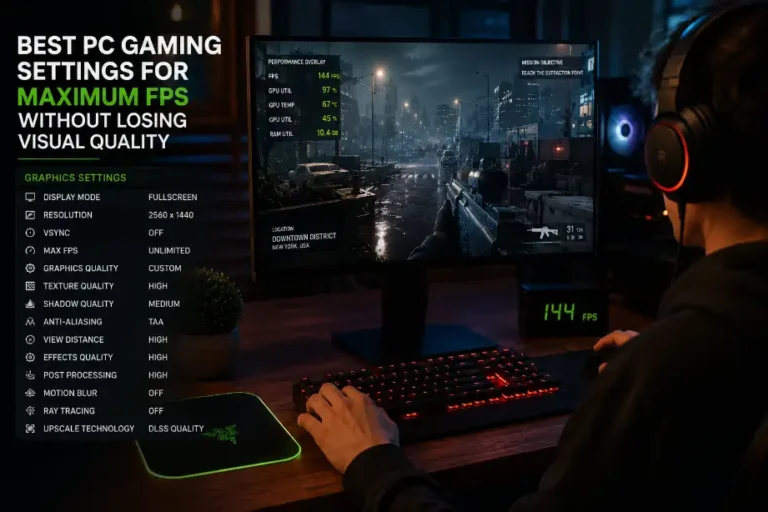
The most useful change is not unlimited conversation. It is context: a character may refer to nearby events, explain a system in response to a question or select from more situation-aware actions. Generative systems may also reduce the amount of hand-authored dialogue needed for prototypes. For a broader performance context, see our guide to PC settings and frame-rate targets.
Limits designers still have to solve
- Consistency: generated dialogue can contradict lore, quests or earlier statements unless knowledge and outputs are tightly constrained.
- Safety and moderation: open-ended input can prompt unsuitable or unintended responses.
- Latency and cost: speech and model inference add processing, memory, network or service costs.
- Determinism and testing: authored branches are easier to reproduce than variable model output.
- Accessibility: voice interaction needs text alternatives, captions and conventional controls.
- Privacy: a game should explain when voice or text is sent to an online service and how it is handled.
Hardware also matters. On-device inference competes for CPU, GPU and memory resources, while cloud inference depends on a connection. That trade-off resembles the wider choice discussed in cloud gaming versus a local PC, although an NPC service and a streamed game are not the same product.
How to evaluate an “AI NPC” claim
- Ask which layer is new: dialogue, decision-making, animation, navigation or training.
- Look for a named game build or public demo, not only a platform capability.
- Check whether processing is local or cloud-based and whether an account or connection is required.
- Prefer evidence about player-facing behavior over broad claims such as “human-like” or “fully autonomous.”